

Look, I get it: you've probably been doing exercises that someone told you were "good for sciatica," but now you're stuck. Either they stopped working, or worse, you're afraid that doing MORE will make things worse.
The truth? Most people progress their sciatica exercises completely wrong. They add more reps, hold stretches longer, or randomly try harder variations: all without understanding WHY they're doing what they're doing or WHAT their body actually needs next.
After helping 5,200+ clients find lasting relief through our 180° Sciatica Solution at Sciatica Relief Now LLC, I can tell you that progressing exercises isn't about doing "more": it's about doing the RIGHT things at the RIGHT time in the RIGHT sequence.
And that's exactly what we're going to cover today.
1. UNDERSTAND WHERE YOU ARE IN THE HEALING PROCESS (MOST PEOPLE SKIP THIS STEP)
Before you can progress ANYTHING, you need to know where you stand right now.
Here's what I tell every single client: healing sciatica follows a specific three-step process that I've refined over years of clinical practice. IF you try to skip ahead, you'll either stall out or re-aggravate your symptoms. But IF you respect where your body is TODAY, you'll progress faster than you ever thought possible.
The three foundational steps are:
1. BALANCE OUT IMBALANCES – This is where most people are when they first come to us. Your body is asymmetrical, one side is weaker, tighter, or compensating, and that imbalance is creating the nerve irritation.
2. STABILIZE IN NEWLY BALANCED POSITION – Once you've addressed the imbalances (this usually takes 2-4 weeks if done correctly), your body needs to HOLD that new alignment under increasing demands.
3. RETURN TO NORMAL SLOWLY AND WISELY – Finally, you rebuild your tolerance to real-life activities without triggering old patterns.
Most exercise progressions you find online completely ignore this framework: they just assume everyone should do the same exercises in the same order. That's why they fail.

2. FIND YOUR DIRECTIONAL PREFERENCE (THIS IS YOUR ROADMAP)
Here's something that's foreign to most people but absolutely CRITICAL to understand: your body has a directional preference.
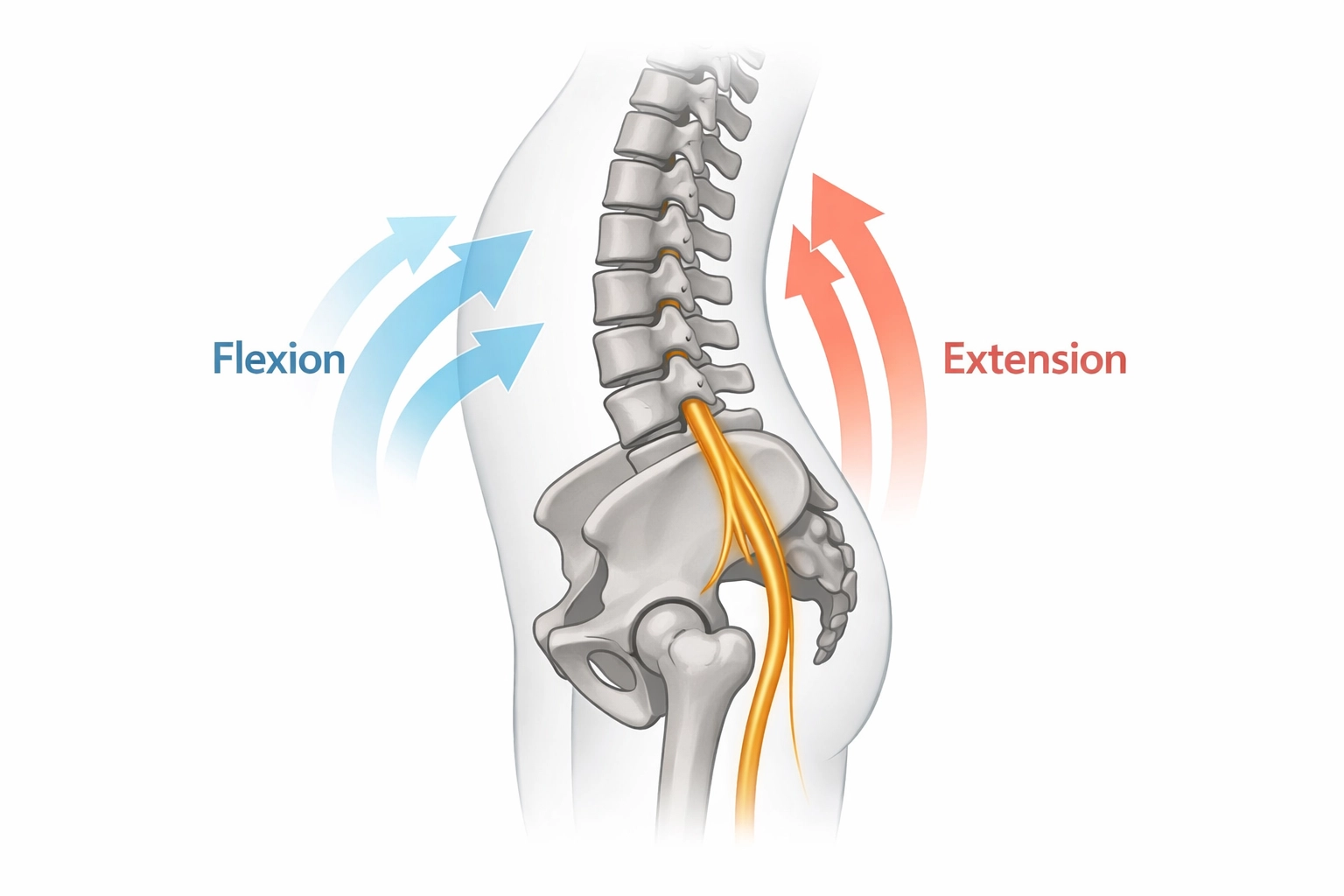
That means your symptoms will either improve with lumbar EXTENSION (backward bending) or lumbar FLEXION (forward bending). Rarely, some people need lateral movements: and that's where our 180° Sciatica Solution comes in.
Here's how to test this safely:
Sit in a chair and gently tilt your pelvis forward and backward. Pay attention to which direction causes your pain to CENTRALIZE (move from your leg toward your back). That's a GOOD sign! That direction is your friend.
BUT: and this is huge: many of my clients discover that neither forward nor backward movements help. Their relief comes from working the NON-PAINFUL SIDE. This is the cornerstone of the 180° approach, and it's why we've earned the America's Best in Medicine badge for our innovative, results-driven methodology.
IF your pain reduces or centralizes with extension, you'll progress through extension-based movements. IF it improves with flexion, you'll follow a flexion progression. IF neither works, you need the balancing approach we specialize in.
3. PROGRESS THROUGH PHASES, NOT RANDOM EXERCISES (THIS IS WHERE MAGIC HAPPENS!)
Once you know your direction, here's how to progress intelligently:
IF YOU'RE IN PHASE 1: BALANCING OUT IMBALANCES
Your exercises should focus on gentle, repetitive movements that restore symmetry. This is NOT the time to "feel the burn" or push through pain.
Start with:
- Simple pelvic tilts (10-15 reps, 3 times daily)
- Gentle nerve sliders that keep your sciatic nerve mobile WITHOUT tensioning it
- For 180° clients: Work the non-painful side with specific stretches and strengthening (15-20 seconds holds, repeated throughout the day)
The goal here? Reduce inflammation, restore normal movement patterns, and create the foundation for everything else. IF you rush this phase, you'll pay for it later!
Duration: 2-4 weeks for most people, but your body will tell you when it's ready (symptoms will reduce by 50-70%)

IF YOU'RE IN PHASE 2: STABILIZING YOUR NEW POSITION
This is where most people either make incredible progress or completely screw things up. The difference? PATIENCE and proper progression.
Now you're adding:
- Increased hold times on stability exercises (work up to 30-60 seconds)
- Introduction of gentle resistance using body weight or light bands
- Nerve tensioners IF you've mastered sliders without flare-ups
- Core and hip strengthening that respects your directional preference
For extension-based progressions: You might move from prone lying to prone on elbows, then to half press-ups, and eventually full cobra-style press-ups. BUT only progress when the previous level feels easy and pain-free!
For our 180° clients: This is when we add MORE complexity to the non-painful side work: incorporating standing exercises, single-leg balance work, and functional movement patterns.
Duration: 3-6 weeks, depending on how long you've had sciatica and your adherence to the program
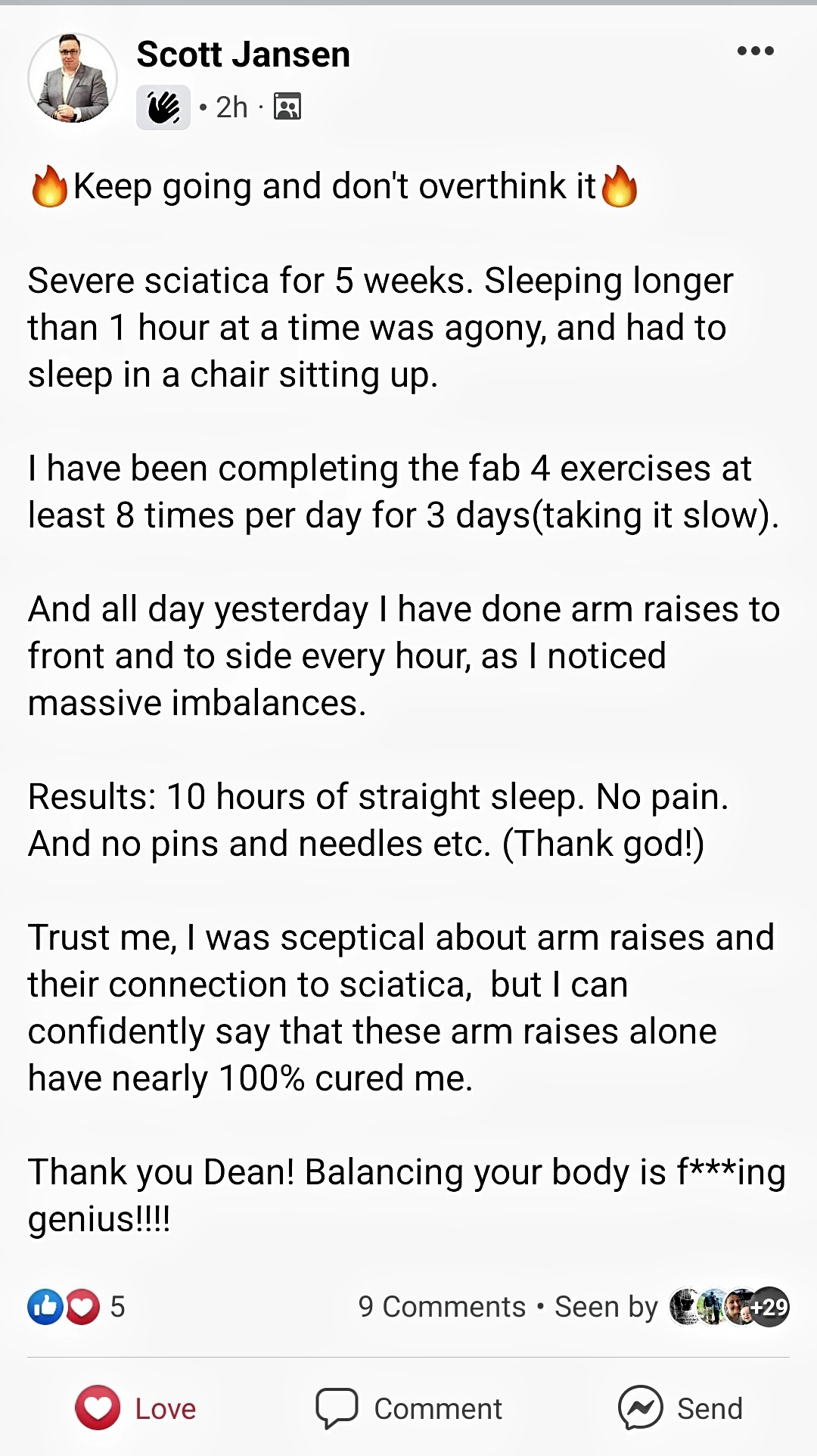
IF YOU'RE IN PHASE 3: RETURNING TO REAL LIFE
This is the phase everyone wants to skip to: and that's exactly why people end up back in pain six months later.
Now you're testing your tolerance for:
- Longer walks (start with 10-20 minutes every 2-3 hours, gradually increasing)
- Lifting and bending with proper mechanics
- Recreational activities you've been avoiding (golf, hiking, gardening)
- Higher-intensity strengthening exercises
The key? Progress ONE variable at a time. Increase duration OR intensity OR frequency: never all three at once.
IF you wake up the next day with increased leg symptoms, you did too much. Back off 25-30% and stay there for another week before progressing again.
4. USE THESE SAFETY CHECKPOINTS (YOUR "AM I DOING THIS RIGHT?" GUIDE)
Here's how to know IF you're progressing correctly:
✓ Your pain should CENTRALIZE (move from foot to calf to thigh to buttock to back)
✓ Your intensity should REDUCE over days and weeks, even IF it temporarily increases during an exercise
✓ You should feel STRONGER and more stable, not just "looser" from stretching
✓ Daily activities should become EASIER, not just less painful
✓ You should need LESS modification, not more, as weeks go by
IF any of these trends go the opposite direction for more than 2-3 days, something's wrong. Don't just "push through": that's how people end up needing surgery or injections they could have avoided.
5. AVOID THESE PROGRESSION KILLERS (SERIOUSLY, DON'T DO THESE!)
After working with 5,200+ clients, I've seen every mistake imaginable. Here are the biggest:
❌ ADDING MORE EXERCISES INSTEAD OF MASTERING FUNDAMENTALS – More isn't better. Better is better. Master three exercises perfectly before adding a fourth.
❌ HOLDING STRETCHES LONGER THAN 30 SECONDS – IF you're stretching correctly, 30 seconds is plenty. Going to 2-3 minutes just creates irritation.
❌ SKIPPING DAYS BECAUSE YOU FEEL GOOD – Consistency beats intensity every time. Even on good days, do your maintenance work (takes 10-15 minutes!).
❌ PROGRESSING BASED ON CALENDARS INSTEAD OF SYMPTOMS – Your body doesn't care that it's been "two weeks." Progress when your symptoms tell you it's time.
❌ IGNORING THE NON-PAINFUL SIDE – This is the biggest one! Most people obsess over the painful side and completely neglect the imbalances causing the problem in the first place.

YOUR NEXT STEPS START TODAY
Here's what I want you to do right now:
1. Assess where you are in the three-phase healing process (be honest!)
2. Test your directional preference using the seated pelvic tilt test
3. Choose 2-3 exercises appropriate for your current phase and commit to doing them daily for the next 7 days
4. Track your symptoms each morning and evening: you should see measurable improvement within 3-5 days IF you're doing the right things
IF you're confused about which exercises to do, or IF you've been doing exercises for weeks without progress, you might need the personalized guidance we provide through the 180° Sciatica Solution. We've helped 5,200+ clients find relief using our unique balancing approach, and we'd love to help you too.
The difference between staying stuck and finally healing comes down to having the right roadmap. You don't need more random exercises from YouTube: you need a systematic progression that matches where YOUR body is TODAY.
Ready to stop guessing and start progressing? Visit us at Sciatica Relief Now or check out our client testimonials to see the results real people are getting with our approach.
Your pain-free life is waiting; you just need the right plan to get there.
#sciatica #sciaticapain #sciaticareliefnow #naturalhealing #physicaltherapy #180sciaticasolution