

Reviewed by Dean Volk, MPT, November 2026
Here’s the short answer: piriformis syndrome is when the piriformis, a small muscle deep in your buttock, irritates the sciatic nerve that runs right past it. You feel it as deep buttock pain that’s worse when you sit and can run down the back of your leg. The muscle’s rarely the real culprit, though. It’s tight because it’s covering for an imbalance, which is why stretching and rolling the painful side keeps it flaring. What helps is calming it down and working the side that doesn’t hurt.
This is for you if you’ve been told you have piriformis syndrome, you’ve stretched it, rolled on it and had it massaged, and it keeps coming back. I’m Dean Volk, MPT. I’ve helped 10,000+ sciatica sufferers break their sciatica, including 5,200+ online since 2018, with no drugs, no injections and no surgery. I coach people over Zoom all over the country, and in their homes around Scottsdale and Phoenix. On average, clients report a 50% improvement in 3 to 5 weeks and 85% by 8 weeks (self-reported; results vary).
What is piriformis syndrome?
It’s sciatica-like pain caused by a tight, irritable muscle deep in your buttock.
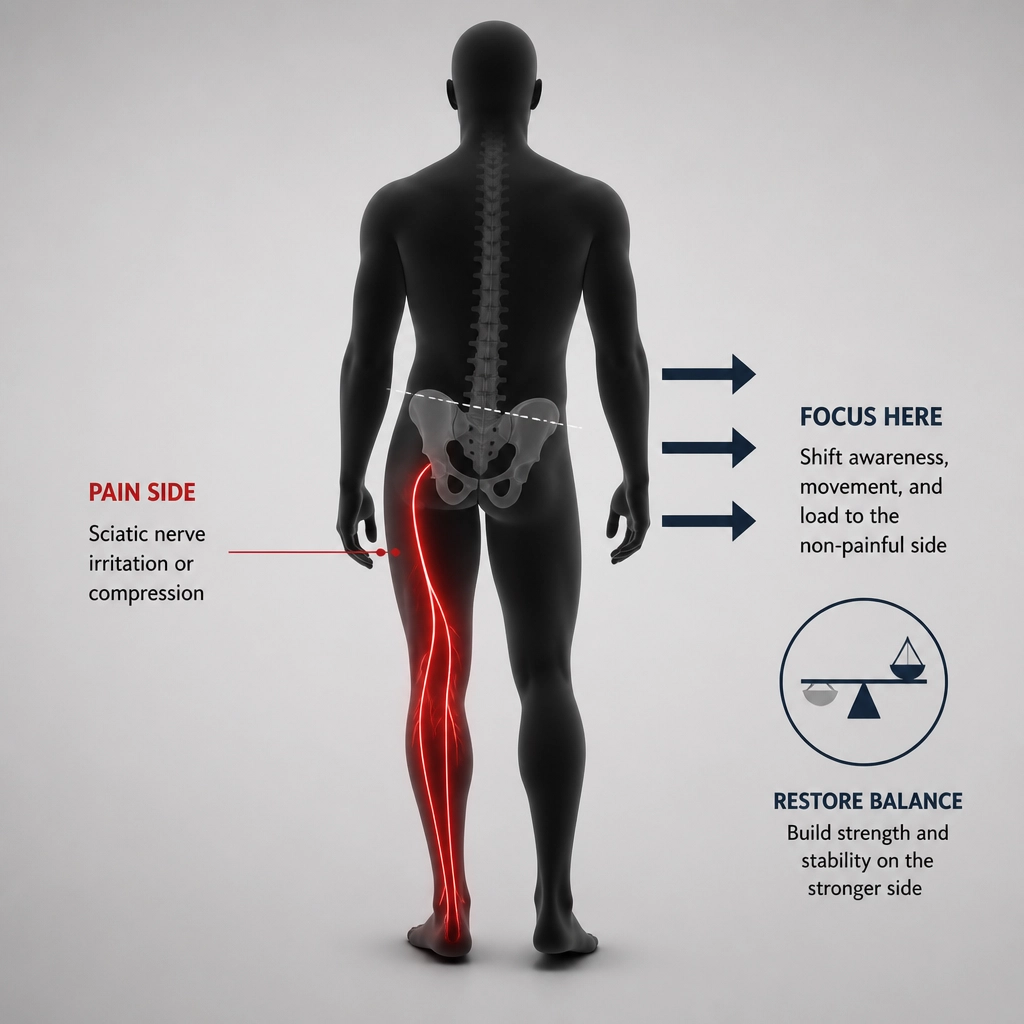
The piriformis runs from the base of your spine to the top of your thigh bone, and it helps turn your hip out. The sciatic nerve runs right past it, and in some people straight through it. When that muscle stays tight and irritable, it can squeeze or irritate the nerve. The pain behaves exactly like sciatica.
What does piriformis syndrome feel like?
- A deep ache or burn in one buttock.
- Pain that gets worse when you sit, especially on hard chairs or in the car.
- Pain running down the back of your thigh.
- Flare-ups when you cross your legs, climb stairs, squat or turn your hip.
- A tender knot deep in your buttock.
Sound a lot like sciatica? It does, and that’s the problem. The two overlap so much that you can’t tell them apart from where it hurts. I break down the differences in Is It Sciatica or Piriformis?
What causes piriformis syndrome?
Almost never the piriformis by itself.
Muscles that small don’t become bullies for no reason. They tighten because they’re covering for something: a pelvis that isn’t level, a hip that’s stopped doing its share, years of sitting, months of guarding after a flare-up. Attack the piriformis alone and you’re punishing the employee, not the manager.
Why aren’t piriformis stretches and rolling working?
Because you’re adding fuel to a fire that’s already burning.
I hear the same two things from almost everyone with piriformis syndrome. Their chiropractors, physios, massage therapists and doctors told them to stretch the piriformis to loosen it up, and to roll on a foam roller, tennis ball or lacrosse ball to calm the spasms.
When I ask how that’s working, I get one of three answers:
- “It gives me a little relief, but the pain comes back pretty soon.”
- “It’s excruciating, but I push through and do it anyway.”
- “I quit a long time ago because it hurt too much.”
I was trained the same way. For my first 17 years I worked on piriformis pain like that too. The only people it seemed to help were the ones who’d had it for a very short time. Everyone who’d suffered for more than a few months got very little out of it.
One woman I worked with in Massachusetts had been doing this for 20 years, along with medication and 3 to 4 injections a year. Twenty years of stretching and rolling a muscle that kept telling her to stop.
Think about it this way. If you watched me throw kindling on a fire and tell you I was trying to put it out, what would you say? Stop feeding it. Once you stop feeding it, it burns down and calms on its own.
What helps piriformis syndrome instead?
Stop feeding the fire, then fix the imbalance behind it.
My two tips for calming it down, starting today:
- Stop stretching the painful piriformis. That includes the figure 4 and pigeon pose on the side that hurts.
- Stop rolling on it. No more tennis balls, foam rollers or elbows dug into the sore spot.
Then work the side that doesn’t hurt. That’s the 180° part. I explain why in Should You Stretch the Non-Painful Side for Sciatica? Here’s the order:
- Balance. We work the opposite side to get your pelvis level and both hips sharing the load.
- Stabilize. You get a short routine of your own to hold that balance, so the piriformis has no reason to go back on guard duty.
- Return. You go back to sitting, driving, walking and the things you love, slowly and wisely.
Tamara Edwards had piriformis syndrome and sciatica and was “walking with a cane and dragging my left leg” before we met. Her words a few years later: “I CrossFit four to five days a week and walk 20-40 miles a week.”
How can I find out what my body needs?
Start with the free 3-Day Sciatica Proof Lab. That’s three free 1-on-1 Zoom sessions with me, 30 minutes each. I watch how you move, find your pattern, and walk you through Step 1, so you can feel the difference in your own body before you spend a dime. If you live around Scottsdale or Phoenix and want to work in person, I come to your home.
Apply for the free 3-Day Sciatica Proof Lab
Frequently asked questions
What is piriformis syndrome?
It’s when the piriformis, a small muscle deep in your buttock, irritates the sciatic nerve that runs right past it. It causes deep buttock pain that’s often worse sitting and can run down the back of your leg, a lot like sciatica.
Should I stretch my piriformis?
Not on the side that hurts. That muscle’s usually tight because it’s protecting you, so stretching it tends to give a few minutes of relief and then a worse night. Work the side that doesn’t hurt instead.
Is rolling on a tennis ball or foam roller good for piriformis syndrome?
Usually not on the painful side. Digging into a muscle that’s already aggravated keeps it aggravated. Stop rolling it and give it a chance to calm down.
What’s the difference between piriformis syndrome and sciatica?
Sciatica usually starts with a nerve root in the lower back. Piriformis syndrome irritates the same nerve deeper down, in the buttock. The symptoms overlap so much that pain location alone can’t tell you which one you have.
How long does piriformis syndrome take to get better?
It depends on how long you’ve had it and what’s driving it. With the 180° approach, clients report an average 50% improvement in 3 to 5 weeks and 85% by 8 weeks (self-reported; results vary).
When should I see a doctor right away?
See a doctor right away if you lose bladder or bowel control, have numbness in your groin or inner thighs, or your leg’s getting weaker. Those are emergency signs, not something to stretch or roll through.