

You bent down to pick up something. Or you twisted wrong getting out of the car. Or maybe you just woke up and BAM, your sciatica is screaming at you like it hasn't in months.
The panic sets in immediately. Your mind races: "Do I need the ER? Should I call my doctor? Where are those pills? Is this going to last for weeks again?"
I know that feeling. I've worked with 5,200+ clients who've been exactly where you are right now, frozen in pain, terrified this flare-up will derail everything.
But here's what most people don't realize: The first 48 hours of a flare-up are CRITICAL. What you do (or don't do) in this window determines whether you bounce back in days or suffer for weeks.
And I'm going to tell you something that might sound crazy: The standard advice, ice, rest, and wait it out, is only HALF the story. There's a specific sequence that can dramatically reduce your recovery time, and it starts with understanding WHY this flare-up happened in the first place.
1. STOP, BREATHE, AND ASSESS (WITHOUT THE PANIC)
First things first: You need to separate the PAIN from the PANIC.
Your nervous system is already on high alert. Adding anxiety and catastrophic thinking ("What if this never gets better?") only amplifies the pain signals your brain is processing. I've seen this pattern in thousands of clients, the fear of movement actually makes the pain worse.
Here's what you DO instead:
Find a comfortable position, lying on your side with a pillow between your knees, or on your back with your knees supported. Take slow, deep breaths for 2-3 minutes. This isn't woo-woo stuff; you're literally calming your nervous system so you can think clearly about your next steps.
Now ask yourself: What was I doing when this started? Which side hurts? Can I stand without excruciating pain?
These answers matter because they reveal which side of your body is OUT OF BALANCE, and that's the key to everything that comes next.

2. APPLY STRATEGIC COLD THERAPY (BUT NOT WHERE YOU THINK)
Yes, ice can help in the first 48 hours, BUT here's what's different about the 180° Sciatica Solution approach:
Most people immediately ice the side that hurts. That makes sense, right? Reduce inflammation, numb the pain.
But IF your flare-up happened because one side of your body is compensating for weakness or tightness on the OTHER side (which is the case 90% of the time), you might be treating the SYMPTOM instead of the CAUSE.
Here's what I recommend:
Apply a cold pack (wrapped in a towel, never directly on skin!) to your lower back for 15-20 minutes at a time, several times throughout the day. BUT also pay attention to your non-painful side. Is it tight? Is it doing all the work to keep you upright?
The goal in these first 48 hours isn't just to reduce inflammation, it's to START rebalancing your body so the painful side can actually HEAL instead of being under constant stress.

3. REST STRATEGICALLY (NOT COMPLETELY)
This is where most people go wrong, and it costs them WEEKS of unnecessary suffering.
Complete bed rest sounds like a no-brainer when you're in agony. But research and my experience with 5,200+ clients tells a different story: Extended inactivity actually SLOWS your recovery and increases the risk of chronic pain.
Here's what strategic rest looks like:
HOUR 1-6: IF the pain is severe (7/10 or higher), take the weight off your feet. Lie down in a supported position. Use lumbar support, a small pillow or rolled towel behind your lower back to maintain natural spine alignment. This isn't about staying still; it's about taking PRESSURE off the inflamed nerve.
HOUR 6-24: Start gentle position changes every 30-60 minutes. Just shifting from lying down to sitting up (with proper support) to standing for 2-3 minutes keeps your muscles from locking up and improves circulation to the area.
HOUR 24-48: IF pain has dropped below a 7/10, begin VERY gentle movement. And here's the kicker, focus on your NON-PAINFUL SIDE.
Walk slowly and deliberately, paying attention to whether you're limping or favoring one side. The goal is to restore BALANCE, not to push through pain on the affected side.
4. STRETCH YOUR NON-PAINFUL SIDE (YES, REALLY)
This is the part that sounds completely backwards to most people, and it's exactly why the 180° Sciatica Solution has helped over 5,200 clients when traditional approaches failed.
When your painful side is screaming, your brain's first instinct is to stretch it, massage it, or manipulate it. But IF that side is already inflamed and angry, poking at it only makes things WORSE.
Here's what you do instead:
IF your right leg is painful, stand (with support nearby, a counter or wall) and do GENTLE stretches on your LEFT side. Slow, controlled movements: no bouncing, no forcing.
You're not trying to feel a deep stretch. You're looking for subtle release and improved range of motion on the side that's been COMPENSATING and overworking.
Why does this work? Because when you restore balance and flexibility to your non-painful side, it STOPS pulling your pelvis out of alignment. That reduces the mechanical stress on your painful side and gives it space to actually heal.
This is Step 1 of my 3-step system: BALANCE OUT THE IMBALANCES. Even in the first 48 hours of a flare-up, you can start this process.

5. AVOID THESE CRITICAL MISTAKES
The first 48 hours is NOT the time to be a hero. Here's what you absolutely MUST avoid:
NO heavy lifting: not even "just this one thing." Your body is vulnerable right now, and one wrong move can turn a 3-day flare-up into a 3-week nightmare.
NO sitting on soft couches or car seats for extended periods. Soft surfaces let your pelvis sink and rotate, which compresses the sciatic nerve further. Use lumbar support ALWAYS during this window.
NO high-impact activities. I don't care if you "feel better" after 36 hours: running, jumping, or aggressive stretching can re-injure you instantly.
NO stretching or manipulating the PAINFUL side aggressively. I know it's tempting. Don't do it.
And most importantly: NO catastrophizing. "This will never get better" thinking literally changes how your brain processes pain signals. Stay focused on the next 24 hours, not the next 24 years.
6. STABILIZE AND PROTECT YOUR PROGRESS
By hour 48, IF you've followed the steps above, you should notice at least SOME improvement: even if it's just going from a 9/10 pain to a 7/10.
This is Step 2 of my 3-step system: STABILIZE IN YOUR NEWLY BALANCED POSITION.
Here's how:
Continue using lumbar support whenever you sit. Your spine needs consistent reinforcement right now, not mixed messages.
Practice gentle, controlled movements: even if it's just walking from the bedroom to the kitchen and back. Quality over quantity. Smooth, balanced steps.
Monitor your non-painful side. Is it still doing all the work? Are you limping? These are signs you need to keep focusing on restoring balance, not rushing back to "normal."
And keep your mindset focused on PROGRESS, not PERFECTION. You're not trying to be 100% pain-free in 48 hours: you're trying to start the healing process properly so you DON'T end up in this situation again next month.
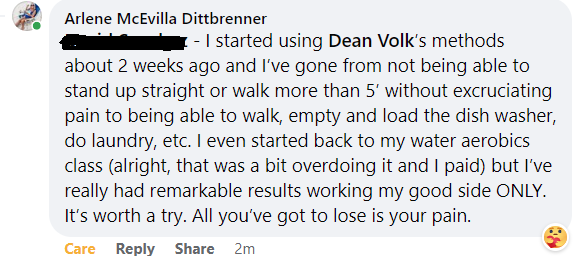
WHAT HAPPENS NEXT (BEYOND THE FIRST 48 HOURS)
IF you've managed the first 48 hours correctly, you're ready for Step 3 of my system: RETURN TO NORMAL SLOWLY AND WISELY.
This is where most people sabotage themselves. They feel 60-70% better and immediately jump back into their old routines: and then wonder why they're back in pain within a week.
Real, lasting recovery requires a strategic progression. You need to continue addressing the body imbalances that caused this flare-up in the first place. You need to strengthen your weaker side, restore proper movement patterns, and build resilience so your body can handle stress without breaking down.
That's exactly what the 180° Sciatica Solution does: and it's why I've been recognized by America's Best in Medicine for this unique approach.
WHEN TO SEEK PROFESSIONAL HELP
Most sciatica flare-ups respond well to this strategic approach within 48-72 hours. BUT there are red flags you can't ignore:
IF you experience progressive weakness in your leg (like foot drop or inability to stand on tiptoes), loss of bladder or bowel control, or pain that's getting WORSE despite following these steps: you need to contact a healthcare provider immediately. These are signs of a more serious issue that requires urgent attention.
For everything else: IF you're ready to finally address the root cause of your sciatica instead of just managing flare-ups: I can help.
The first 48 hours are about damage control and starting the rebalancing process. But the next 4-8 weeks are about ENDING this cycle for good.
Ready to stop living in fear of the next flare-up? Visit sciaticareliefnow.net or contact Dean Volk directly to learn how the 180° Sciatica Solution can work for you: just like it has for 5,200+ other clients who finally found lasting relief.
#sciatica #sciaticapain #sciaticaflareup #sciaticareliefnow #backpain #nervehealth #painrelief #physicaltherapy