

Reviewed by Dean Volk, MPT, November 2026
Here’s the short answer: the biggest sciatica stretching mistake is stretching the leg that hurts. The others follow from it: hamstring and figure 4 stretches on the painful side, toe touches, long holds, and stopping as soon as you feel a little better. What works instead is working the side that doesn’t hurt, gently, and then locking in the balance.
This is for you if you’re 40, 60 or 75, you stretch every day, you’ve watched the YouTube videos, maybe you’ve done physical therapy, and you’re still hurting. I’m Dean Volk, MPT. For my first 17 years I taught people to stretch what hurts. Then I flipped it 180 degrees. Today I coach people online over Zoom all over the country, and in their homes around Scottsdale and Phoenix. No drugs, no injections, no surgery. I’ve helped 10,000+ sciatica sufferers break their sciatica, including 5,200+ online since 2018. On average, clients report a 50% improvement in 3 to 5 weeks and 85% by 8 weeks (self-reported; results vary).
Why isn’t my stretching helping my sciatica?
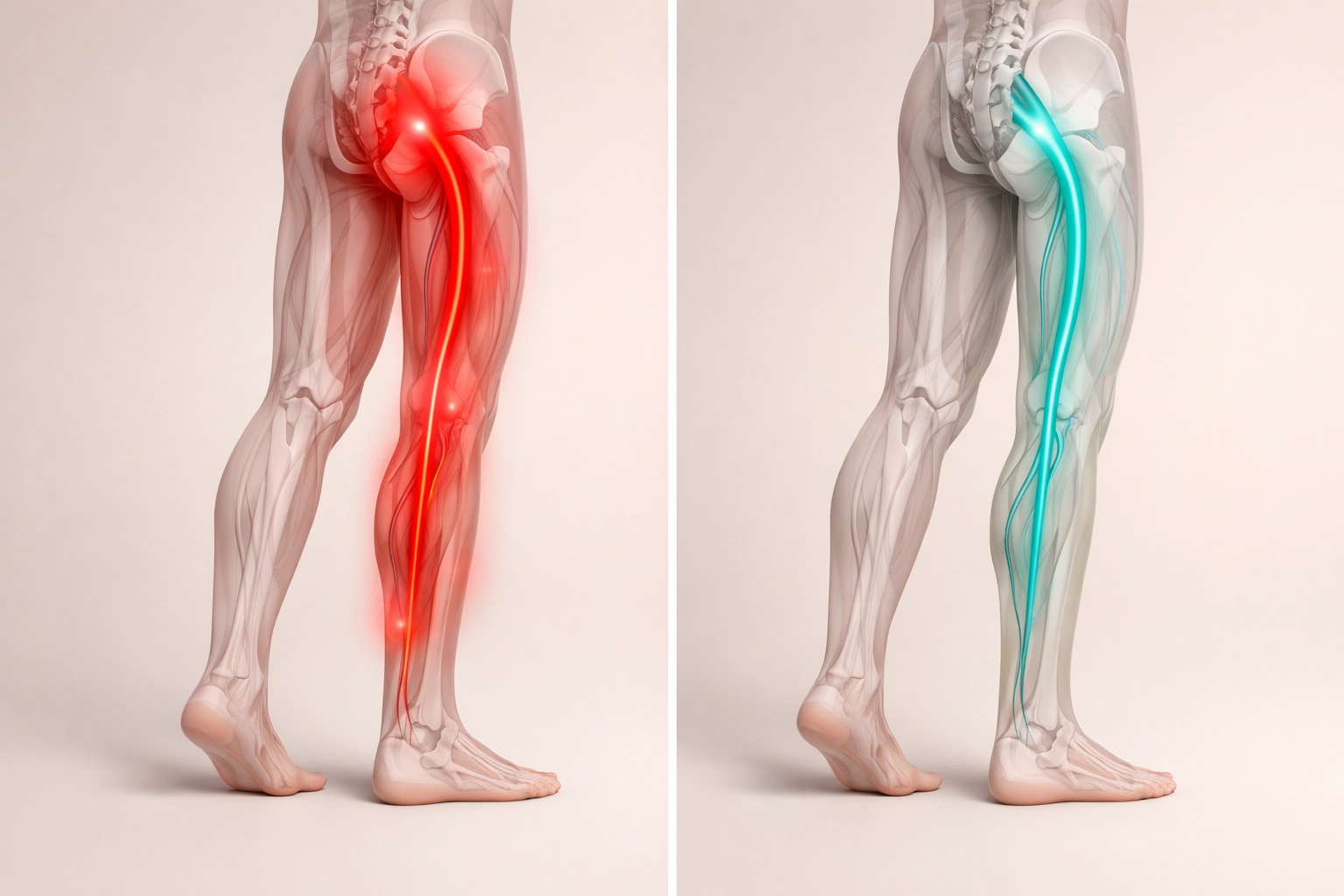
Because your nerve isn’t tight. It’s irritated, and an irritated nerve doesn’t want to be pulled on.
Think of a frayed electrical wire. Grab both ends and pull, and it frays more. That’s what a hard stretch does to an angry sciatic nerve. Your brain feels the threat and tells the muscles around the nerve to clamp down and protect it. So you get a few minutes of relief, and two hours later, or the next morning, the pain’s right back. Sometimes it’s worse.
That’s not you doing the stretch wrong. It’s the stretch aimed at the wrong thing.
What are the 7 most common sciatica stretching mistakes?
- Stretching the side that hurts. It feels logical. The leg feels tight, so you pull on it. But that tightness is your body protecting the nerve, and pulling on it keeps the alarm ringing.
- Hamstring stretches on the painful leg. The sciatic nerve runs right through the back of your thigh, so lying on your back and pulling that leg up stretches the nerve along with the muscle. More on that in why hamstring stretches can make sciatica worse.
- The figure 4 stretch on the painful side. The internet loves it for piriformis and glute tightness. On the side that hurts, it puts tension right where the nerve’s most sensitive. It might feel good in the moment, and then you pay for it.
- Toe touches and forward folds. Sitting, standing or wide-legged, they all put a big stretch on your whole nervous system at once. When the nerve’s already angry, that’s way too much.
- Holding stretches too long. A lot of people hold for 60 to 90 seconds, thinking longer is better. With sciatica it isn’t. Gentle holds of 15 to 20 seconds are plenty.
- Doing the same stretches on both sides. Sciatica is a one-sided problem. If your body’s already shifted to one side, doing everything evenly just keeps the imbalance in place.
- Stopping when you feel better. You finally get some relief, so you quit. But relief without stability doesn’t last, and the old pattern creeps right back in.
What should I do instead of stretching the painful side?
Work the side that doesn’t hurt. If your sciatica’s in your left leg, we start on the right.
I know it sounds backwards. When I tell new clients to leave their painful leg alone, they look at me like I’ve lost my mind. But the side that hurts is usually the victim, not the cause. It’s been overloaded because the other side isn’t pulling its weight. Balance the body from the non-painful side, and the nerve finally gets the break it needs. I explain the whole idea in Should You Stretch the Non-Painful Side for Sciatica?
Christopher Doubt spent a full year on new mattresses, hot baths, massage, dry needling and “doing stretches that I found on YouTube,” and it “kept getting worse and worse.” He thought I was “just another YouTube snake oil stretch routine.” His words after: “Within a week it stopped getting worse… Within 3 months I could drive 6 hours, work on my feet for 2 hours and hop back in my car for another 6 hours home. Best of all. I could sleep without drugs.”
What are the 3 steps that work when stretching doesn’t?
Balance, Stabilize, Return, in that order.
- Balance. We work the opposite side, the one your body’s been compensating on, to take pressure off the nerve.
- Stabilize. You get your own short routine to hold the new balance. Not a sheet of 20 generic exercises. Just the few moves your body actually needs.
- Return. You go back to walking, golf, travel and the grandkids slowly and wisely, so you don’t undo weeks of progress in one afternoon.

Kit Cummings, three weeks in: “It is gently working. I see nice improvement with my right leg. I no longer walk a hunchback.”
Looking for which stretches fit this approach? Read Best Stretches for Sciatica? Why You’re Working the Wrong Leg.
How can I find out what my body needs?
Start with the free 3-Day Sciatica Proof Lab. That’s three free 1-on-1 Zoom sessions with me, 30 minutes each. I watch how you move, find your pattern, and walk you through Step 1, so you can feel the difference in your own body before you spend a dime. If you live around Scottsdale or Phoenix and want to work in person, I come to your home.
Apply for the free 3-Day Sciatica Proof Lab
Frequently asked questions
Why does stretching make my sciatica worse?
Because you’re pulling on a nerve that’s already irritated. Your body reads that as a threat and tightens the muscles around it, so the relief fades and the pain often comes back stronger.
Should I stretch the side that hurts?
Usually not as your main approach. In the 180° approach you start on the side that doesn’t hurt, because that’s where the imbalance usually lives.
How long should I hold a stretch for sciatica?
Gentle holds of 15 to 20 seconds. Long 60 to 90 second holds tend to irritate the nerve more, not less.
Are hamstring stretches bad for sciatica?
On the painful leg, they’re one of the most common mistakes I see, because the sciatic nerve runs right through the back of the thigh. Leave that leg alone and work the other side.
What should I do instead of stretching the painful side?
Balance your body from the non-painful side, stabilize that new balance, then return to normal activity slowly. That’s the Balance, Stabilize, Return order of the 180° approach.
When should I see a doctor right away?
See a doctor right away if you lose bladder or bowel control, have numbness in your groin or inner thighs, or your leg’s getting weaker. Those are emergency signs, not something to stretch through.