

You are not broken. You may have been treated backwards.
You have tried everything. Medications, injections, chiropractic care, physical therapy, stretching, rest, and exercises. Perhaps each approach gave you a short break from the pain, but the burning, tingling, numbness, or shooting pain returned.
Now you are wondering whether non-invasive sciatica treatment simply does not work for you.
I know how frustrating that feels. You are not crazy. You are not failing. You are not asking for too much because you want to walk, travel, drive, sleep, and enjoy your family without planning your entire day around your leg.
BUT here is the question most people never get asked: What if the problem is not non-invasive care itself? What if you have been treating the painful side instead of correcting the imbalance that keeps irritating the nerve?
That is where my 180° different approach begins.
Why treating the painful side seems logical
When your right leg hurts, everyone naturally looks at the right leg. When your left buttock burns, the left hip and lower back become the focus. You are told to stretch, press, mobilize, or strengthen the area that is shouting the loudest.
It makes sense on the surface. But your painful side is often the side reporting the problem, not the side creating the entire pattern.
Your body responds to pain by guarding. One hip may carry more weight. One side of your pelvis may rotate. Your trunk may shift away from the irritation. Over time, the non-painful side can become part of the problem by compensating for the painful side.
If you keep attacking the painful side, you can increase local sensitivity without correcting the way your body is distributing movement and load. You may feel temporary relief, but the pattern remains.
Then you bend, lift, turn, or exercise, and the same irritation returns.
This is foreign to most people: the answer can begin on THE OPPOSITE SIDE.
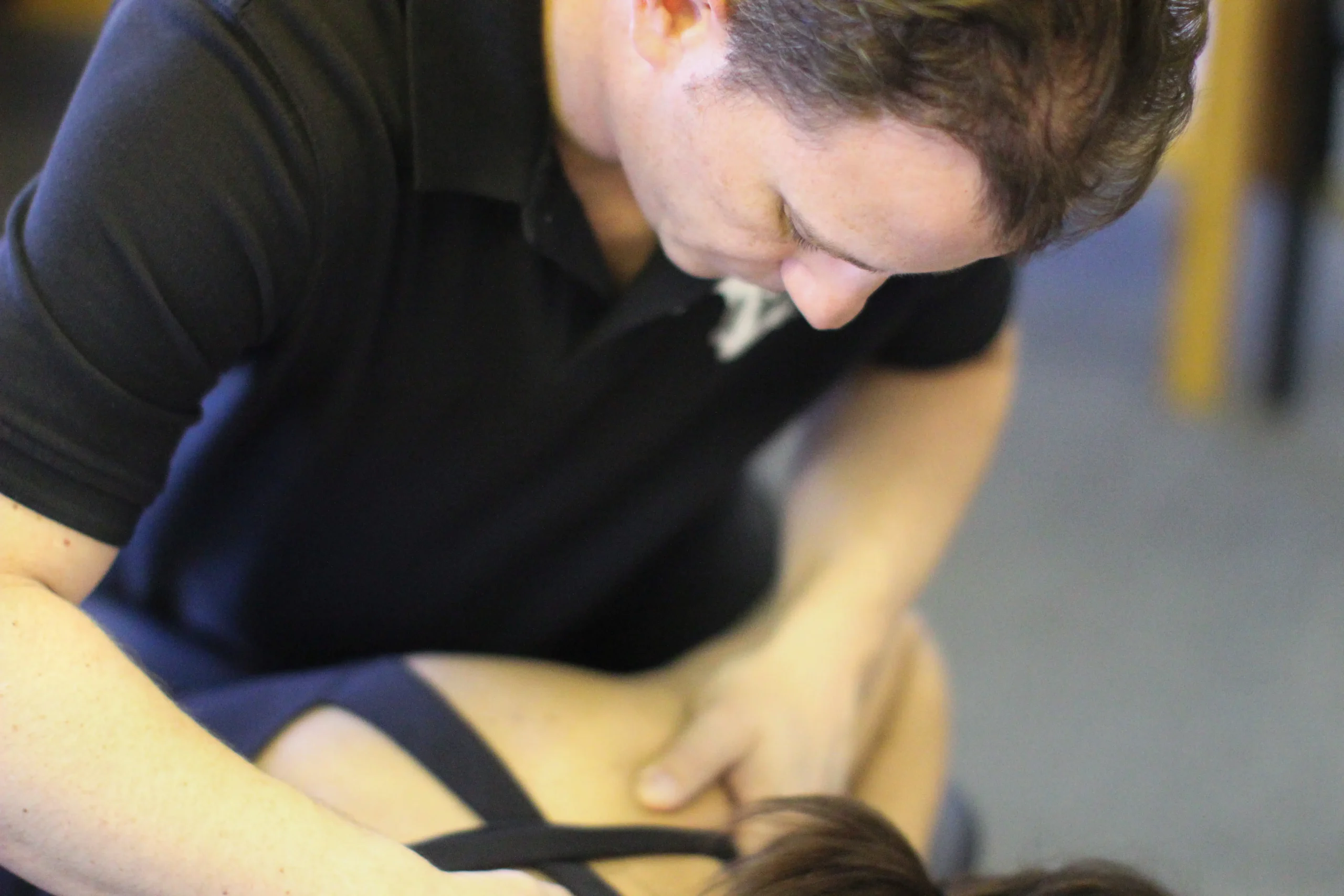
When non-invasive sciatica treatment fails, check the direction
Evidence-based guidelines support non-invasive care for many people with sciatica and lumbar radiculopathy. Education, staying active, and structured exercise are consistently recommended. Manual therapy is generally positioned as an addition to exercise, not a stand-alone solution.
You can review the NICE guideline evidence on low back pain and sciatica and the American College of Physicians clinical guideline.
But broad recommendations do not tell you which side of your body to address first. They do not replace individual assessment. They also do not prove that one specific exercise direction works for every person.
That is why the direction of your care matters. Your symptoms, movement pattern, neurological signs, strength, and response to specific movements all need to be considered.
My clinical experience has shown me that many people who fail standard exercise-based care have not failed because they were lazy or beyond help. They failed because the painful side received all the attention while the compensatory pattern remained untouched.
A no-brainer first step is to stop assuming that more pressure on the painful side equals better recovery.
The 180° reversal I discovered after 17 years
For 17 years, I worked the traditional way and followed the standard approach. I treated the painful side. I used the methods I had been taught. I did everything that appeared logical.
Yet 80-85% of my clients failed to achieve lasting results.
They were trying. They were committed. They wanted their lives back. The issue was the direction of the approach.
When I began examining the opposite side and balancing the body’s compensatory patterns, my success rate rose to 95-97%. That discovery became the foundation of the 180° Sciatica Solution.
Dean Volk, MPT, is a licensed physical therapist who spent 17 years inside the traditional model before developing the 180° Sciatica Solution. Today his work focuses on sciatica education and coaching. Dean has helped more than 10,000 sciatica sufferers, including over 5,200 people online since 2018.
My conclusion is direct: IF the painful side keeps receiving all the attention and your sciatica keeps returning, it is time to examine the opposite side.
The system is Balance -> Stabilize -> Return
The 180° Sciatica Solution is not a random collection of exercises. It follows a three-step system designed to help you identify the imbalance, hold the correction, and return to the activities you value.
Balance
First, you balance the body to relieve pressure and reduce the compensatory pattern. This is where the non-painful side becomes important.
You use carefully selected body-balancing movements, often with short 15-20 second holds, while paying close attention to how your symptoms respond. The goal is not to force a painful range. The goal is to create a better starting position for your body.
A positive response can include less leg tension, reduced burning, easier standing, or symptoms moving closer to the hip instead of farther down the leg. Your response gives you useful information.
Stabilize
Once your body responds to the balancing work, you stabilize that balanced position with custom strengthening exercises. This is where many people stop too early.
Feeling better does not automatically mean your body can hold the new position during real life. Stabilization teaches the muscles around your hips, pelvis, trunk, and spine to share the work more effectively.
IF you skip this stage, your old movement pattern can return when you lift groceries, climb stairs, sit at a desk, or complete a full workday.
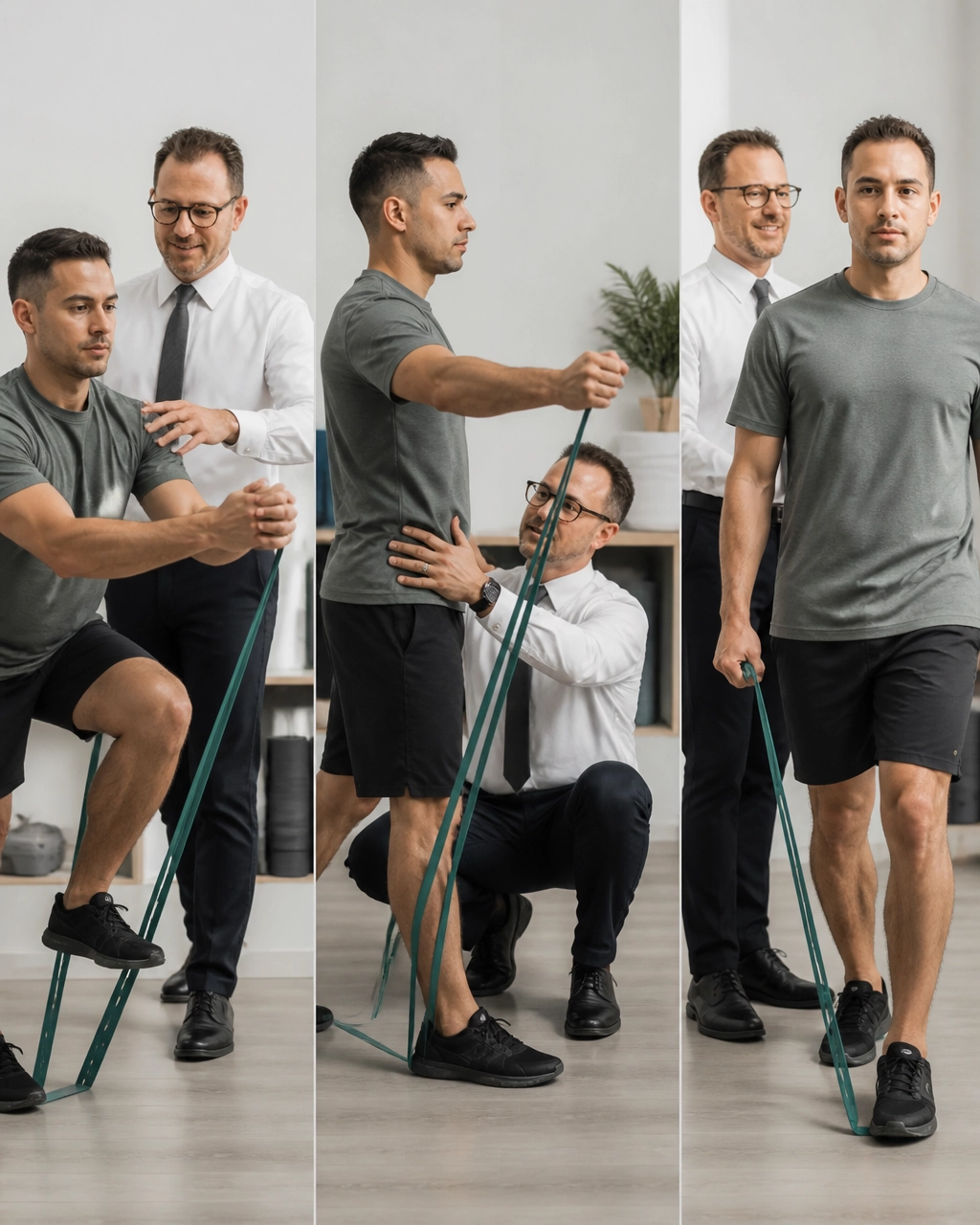
Return
Finally, you learn maintenance techniques that help you return to normal activities with confidence. This is not about staying dependent on a therapist forever. It is about learning to self-assess, recognize an imbalance, and make the right correction before a small warning becomes a major flare.
You gradually rebuild your activity using measurable markers such as step length, standing tolerance, and the time you can complete a normal task without increased leg symptoms.
The goal is to BREAK SCIATICA and RECLAIM YOUR LIFE, not simply to get through another week.
What your symptom response is telling you
Your body’s response during and after movement matters. Do not judge an exercise only by whether it feels difficult. Judge it by what happens to your symptoms over the next 15-20 seconds and during the following several minutes.
Positive signs can include:
- Less pain traveling below the knee.
- Reduced tingling or burning.
- A more even standing position.
- Easier transitions from sitting to standing.
- Improved confidence when taking a normal step.
- A quicker return to baseline after activity.
Stop pushing through a movement if you develop increasing weakness, spreading numbness, or worsening symptoms down the leg. Seek urgent medical attention for loss of bladder or bowel control, numbness around the groin, or severe and progressive weakness.
This article cannot determine the cause of your symptoms. Sciatica can involve lumbar disc herniation, spinal stenosis, nerve-root irritation, or other conditions. A qualified medical professional should evaluate symptoms that are severe, new, progressive, or unclear.
Do not guess. Test the opposite approach with Dean Volk.
I know you are skeptical. After failed non-invasive sciatica treatment, skepticism is reasonable. You do not need another promise. You need to see how YOUR body responds.
That is why I offer the FREE 3-Day Sciatica Proof Lab.
The Sciatica Proof Lab is a FREE 3-day experience consisting of three private 1:1 Zoom sessions with me, Dean Volk. Each session lasts 30 minutes. This is not a webinar, group call, or recording.
I listen to your frustrations, your history, your triggers, and what you have already tried. Then I manually guide you through personalized body-balancing movements, beginning with the side opposite your pain when that direction is appropriate for your presentation.
Day 1 focuses on finding what is driving your pattern. Day 2 applies targeted balancing movements. Day 3 reviews how your body responded and helps you determine your next step.
I do not want you to commit to a program IF your body does not respond. Test it first!!!
Apply directly for the FREE 3-Day Sciatica Proof Lab at www.SciaticaProofLab.com.
Your next step is not more of the same
You have already proven that repeating the same direction does not create lasting relief. That does not mean your body is hopeless. It means you need a more precise look at the relationship between the painful side and THE OPPOSITE SIDE.
The evidence supports staying active and using individualized exercise. My 34+ years of experience and work with more than 10,000 sciatica sufferers have shown me that the missing piece is often the direction of the correction.
The 180° Sciatica Solution is simple to remember: Balance -> Stabilize -> Return.
IF non-invasive sciatica treatment has failed because you keep treating the painful side, stop guessing. Test a 180° different approach and find out what your body does when the opposite side receives the attention.
Start the FREE 3-Day Sciatica Proof Lab today at www.SciaticaProofLab.com. For questions, email info@sciaticareliefnow.net.

You are not broken. You are not crazy. You have been treated backwards long enough. It is time to BREAK SCIATICA and RECLAIM YOUR LIFE!!!
For more guidance, read The proven 180° Solution Framework, 5 steps to balance your body and stop sciatica, and Do you really need an MRI for sciatica?.
Frequently asked questions
What is non-invasive sciatica treatment?
Non-invasive sciatica treatment uses approaches such as education, physical activity, structured exercise, and selected manual techniques without injections or surgery. Medication is a separate medical option that should be discussed with your healthcare professional.
Why would someone work the opposite side of the body?
The opposite side can contribute to the way your pelvis, hips, and trunk compensate around an irritated nerve. Dean Volk’s 180° approach assesses that pattern and uses personalized body-balancing movements instead of automatically placing more pressure on the painful side.
Does working the opposite side work for every person with sciatica?
No single movement approach is appropriate for every person. Your symptoms and neurological signs require individual assessment. The FREE 3-Day Sciatica Proof Lab exists so Dean can listen, observe your movement, and see how your body responds before you make a decision.
What is the FREE 3-Day Sciatica Proof Lab?
It is a FREE 3-day experience with three private 1:1 Zoom sessions with Dean Volk. Each session lasts 30 minutes. Dean listens to your frustrations and manually guides you through personalized body-balancing movements. Apply at www.SciaticaProofLab.com.
How does Balance -> Stabilize -> Return work?
Balance addresses the body’s compensatory pattern. Stabilize uses custom strengthening exercises to help hold the balanced position. Return teaches maintenance techniques so you can resume normal activities and self-correct future imbalances.
#sciatica #sciaticarelief #noninvasivesciaticatreatment #bodybalancing #180degreesdifferent #breaksciatica #deanvolk #physicaltherapy #sciaticaexercises #reclaimyourlife #sciaticaprooflab