

You are exhausted, and you are not imagining it
If you have spent another night staring at the ceiling, shifting your hips, pulling your knees up, and waiting for the burning in your leg to settle, I know how desperate you feel. You are not simply tired. You are worn down from waking every hour, afraid to move, and wondering how you will function tomorrow.
You may have tried a pillow under your knees, a pillow between your legs, a new mattress, heat, stretching, or sleeping on the side that feels protected. You may even have spent the night moving from your back to your left side, then your right side, searching for a position that gives you 20 minutes of peace.
You are not broken. You are not crazy. You are not asking for too much by wanting to sleep through the night. BUT if the same sleep advice keeps failing you, it is time to question the direction you have been given. Everything you have been told about sciatica is not always wrong, but the way your body is being assessed can be 180° backwards.
What IF your sleep position is exposing the imbalance?
Your sleeping position matters because you stay in it for hours. A position that feels harmless for 15 minutes can create pressure, twisting, or tension when your body remains there for six or eight hours. That is one reason sciatica pain at night can feel more intense than it did during the day.
During the day, you are walking, changing chairs, standing, and focusing on other things. At night, the distractions disappear. Your body stays still, your irritated nerve has less room to adapt, and the side you sleep on repeatedly loads the same pattern.
If you sleep directly on the painful side because it feels supported, that may be the exact position keeping the painful hip and pelvis under pressure. If you place extra support beneath the painful side without checking the rest of your body, you can reinforce the twist instead of correcting it.
This does not mean every person with sciatica must sleep on one specific side. Independent guidance from the Cleveland Clinic and the Sleep Foundation recognizes that there is no universal perfect position. The right starting point depends on what your body does in that position.
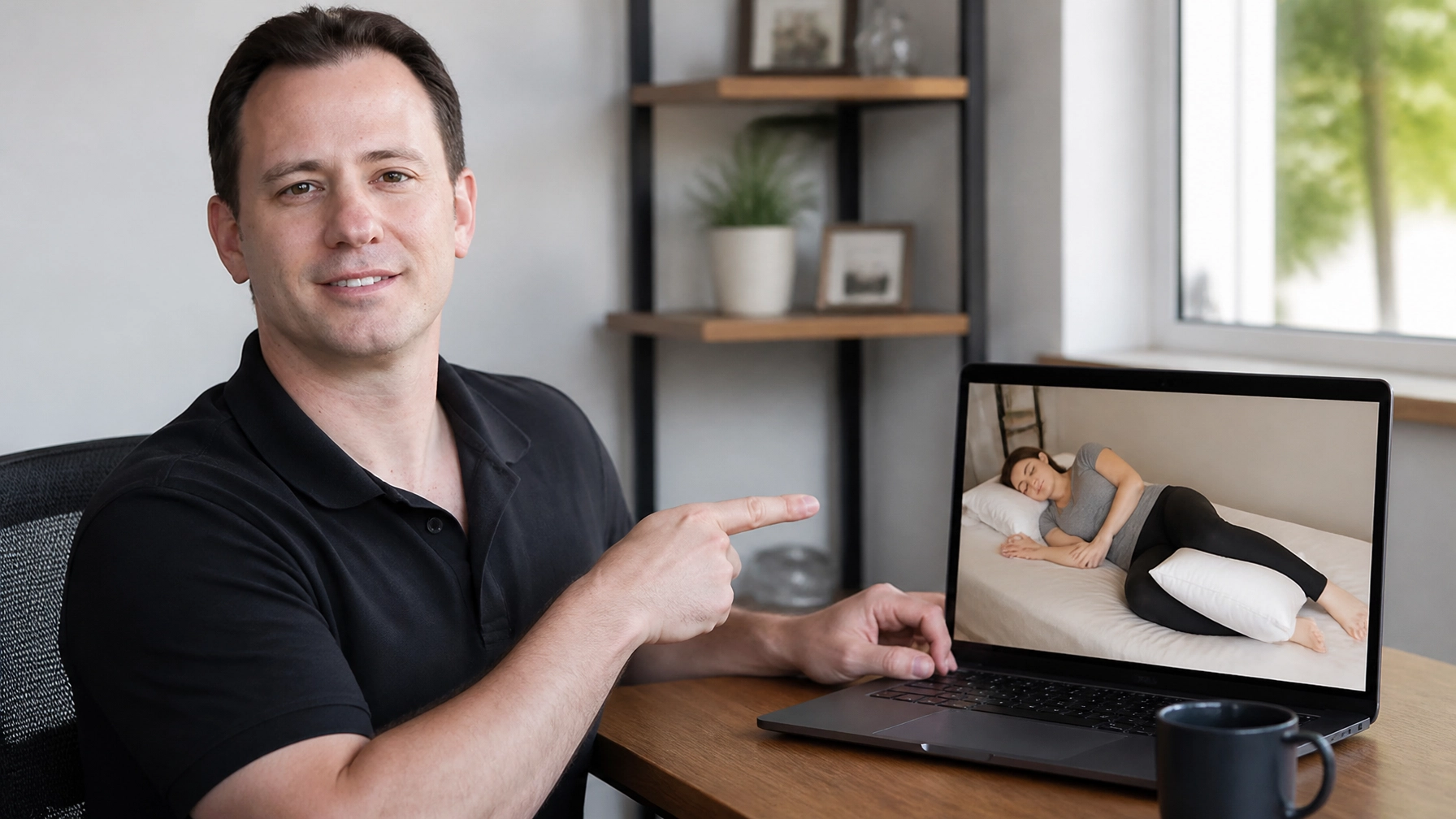
The 180° answer starts with the opposite side
I am Dean Volk, MPT, with more than 34 years of experience in sciatica education and coaching. For most of that time I followed the traditional approach. I treated the painful side because that was where the symptoms appeared. I stretched the painful side, strengthened around the painful side, and followed the standard instructions. For 17 years I worked the traditional way, and roughly 80-85% of my clients did not report long-term relief; results vary, and that was my personal historical experience rather than a general industry statistic.
The clients were not failing. I was looking in the wrong direction.
I discovered that the answer often starts on the opposite side. The non-painful side can become tight, restricted, and overactive as your body compensates. That compensation can pull your pelvis and lower back into a position that keeps stressing the painful side.
That is why I call my approach the 180° Sciatica Solution. Instead of automatically attacking the side that hurts, you assess the entire body and identify which side is creating the imbalance. In many cases, that means starting with the side that does NOT hurt.
This is not a random trick. The company reports a self-reported 95-97% success rate among people who completed the program and reported their final status over the past 8 years; results vary. I have helped more than 10,000 sciatica sufferers, including over 5,200 people online since 2018.
A safe sleep-side test for tonight
You do not need to buy another pillow tonight. You need to pay attention to your body’s response. Use this simple test as a starting point, not as a reason to force through pain.
Begin by lying on the side opposite your painful leg. Keep your knees slightly bent, not tightly curled. Place a pillow between your knees so your hips and legs do not twist forward. Keep your head supported so your neck stays in line with your spine.
Stay there for 15-20 seconds and notice three things:
- Does the pain in your leg reduce, stay the same, or increase?
- Does the burning or tingling move closer to your lower back, or does it travel farther down your leg?
- Do your hips feel stacked, or does your upper hip roll forward and pull your lower back into a twist?
If your symptoms spread farther down your leg, become sharper, or increase quickly, stop the test and change position. Do not force any sleep position simply because someone called it the “best” position. Your body’s response gives you useful information.
You can also test lying on your back with a pillow under your knees. The goal is a comfortable, supported position that does not create a stronger arch or twist in your lower back. A medium-firm sleep surface is commonly recommended for lower back comfort, but your response still matters more than a label on a mattress.
Why pillows alone do not break sciatica
A pillow can change pressure for a few hours. It cannot identify the compensation pattern that has been building in your body for weeks, months, or years. That is why you can wake up feeling better, walk for an hour, and then have sciatica pain at night all over again.
You may be getting temporary comfort without correcting the reason the position becomes painful. The pillow is not the problem. The problem is expecting a pillow to correct a body that is out of balance.
If the painful side keeps getting all your attention, the opposite side can remain unaddressed. That is the part most people miss. The painful side is where you feel the problem, but it is not automatically where the problem begins.
I have seen clients who suffered for years and believed they needed stronger medication, more injections, or more aggressive stretching. Then we changed the direction, worked with the non-painful side, and watched their body respond. One client reported that after a one-on-one conversation and specific movements, it was the first time in eight months they could lie down with barely any pain.
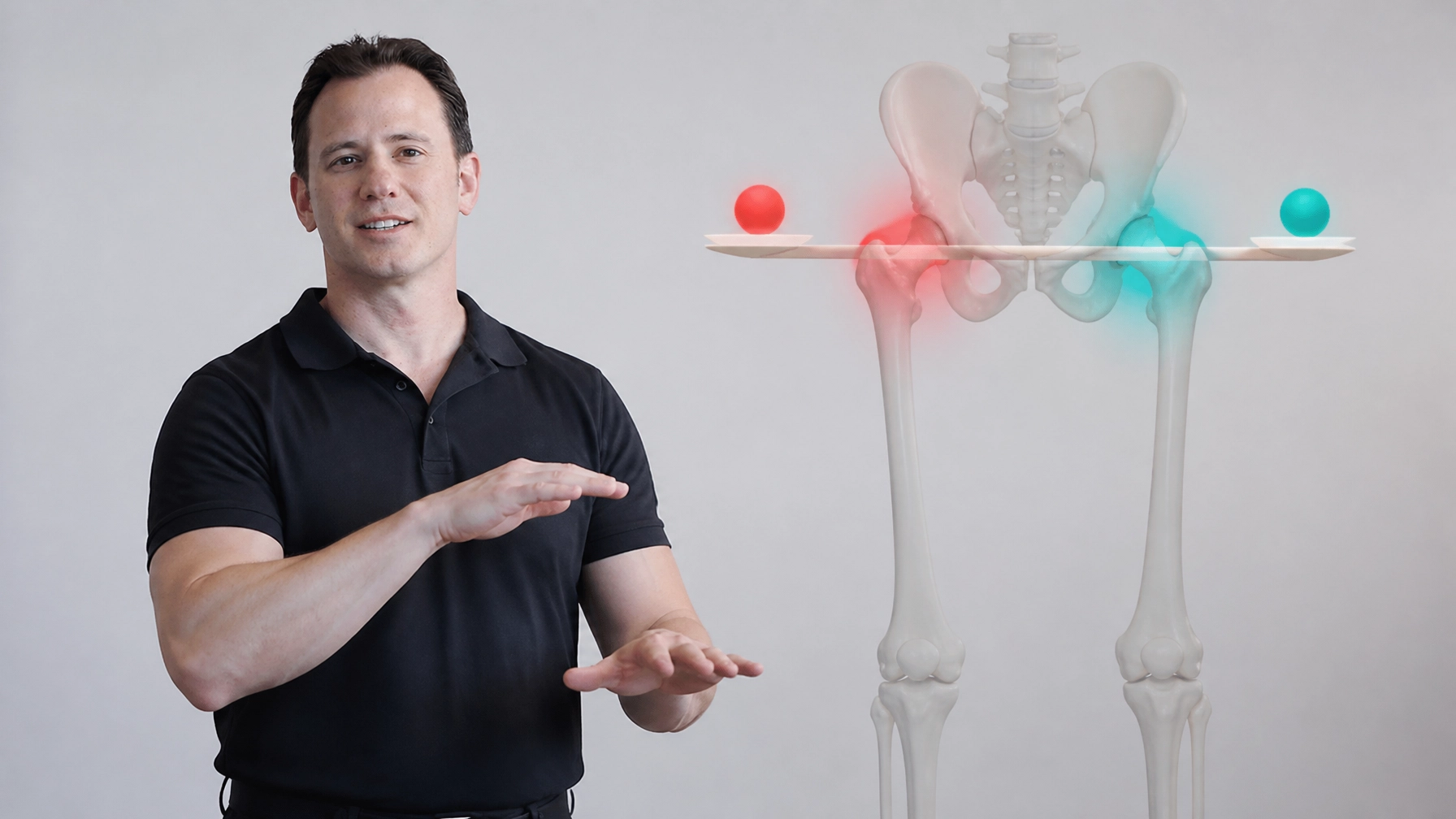
Balance → Stabilize → Return
The 180° Sciatica Solution follows one clear framework: Balance → Stabilize → Return.
Balance
First, you balance the body by identifying the compensation pattern and working with the appropriate side. This often means guiding movements on the opposite side from your pain. The purpose is to reduce the pull that keeps irritating your sciatic nerve.
Stabilize
Next, you stabilize the balanced position with custom strengthening exercises. This is where your body learns to hold the improved position during sitting, walking, sleeping, driving, and daily movement. Generic sciatica exercises do not account for your exact imbalance. Your strengthening needs to match what your body is doing.
Return
Finally, you return to the activities you have been missing. You sleep through the night. You walk without calculating every step. You drive, travel, play with your family, and stop organizing your entire day around your leg. That is what it means to reclaim your life.
Clients average about 50% improvement in 3-5 weeks and 85% by 8 weeks (self-reported); results vary. Timelines vary by person.
Do not guess for another six months
If you have tried everything and your sleep is still being interrupted, you do not need another generic list of stretches. You need to see how YOUR body responds when the opposite side is assessed correctly.
The FREE 3-Day Sciatica Proof Lab gives you that opportunity. It is a free three-day experience consisting of three private 1:1 Zoom sessions with me, 30 minutes each day. This is not a webinar, a recording, or a group call. I listen to your frustrations, watch how you move, and manually guide you through personalized body balancing movements.
Day 1 focuses on finding what is driving your sciatica. Day 2 applies targeted balancing movements. Day 3 reviews how your body responded and helps you decide your next step.
I do not want you to commit to a program IF your body does not respond. Test the approach first. See what changes when you stop automatically working on the painful side and begin looking at the opposite side.
Apply now for the FREE 3-Day Sciatica Proof Lab at www.SciaticaProofLab.com. If you have questions, email info@sciaticareliefnow.net.
Your next step starts tonight
Tonight, stop asking only, “Which pillow should I buy?” Ask a better question: “What is my body doing when I sleep on this side?”
If sleeping on the painful side increases your symptoms, stop forcing that position. Test the opposite side carefully. Watch how your leg responds over 15-20 seconds. Then get personalized guidance instead of guessing your way through another sleepless night.
You are not broken. You have been looking in the wrong direction. The answer is often on the opposite side, and the first step is to test it for yourself.
Learn more about the 180° Sciatica Solution, then apply for the FREE 3-Day Sciatica Proof Lab at www.SciaticaProofLab.com. Reclaim your sleep. Reclaim your energy. Reclaim your life!
FAQ: how to sleep with sciatica
1) What is the best sleeping position for sciatica?
There is no one perfect position for everyone. Start by testing the side opposite your painful leg, or lie on your back with a pillow under your knees. Stop any position that makes your symptoms worse.
2) Why is sciatica worse at night?
It often gets worse at night because you stay in one position too long. That can increase pressure, reinforce the same body imbalance, and make the pain feel louder when everything else gets quiet.
3) How do I stop sciatica pain when lying down?
Use support, test your position for 15-20 seconds, and pay attention to what your body does. IF pain spreads or sharpens, change position. IF you want real change, you need to address the imbalance, not just the symptom.
#howtosleepwithsciatica #sciaticapainatnight #sciaticarelief #bodybalancing #180degreesciaticasolution #breaksciatica #sleepwithsciatica #deanvolk
An Engaging Blog Post
Thanks so much